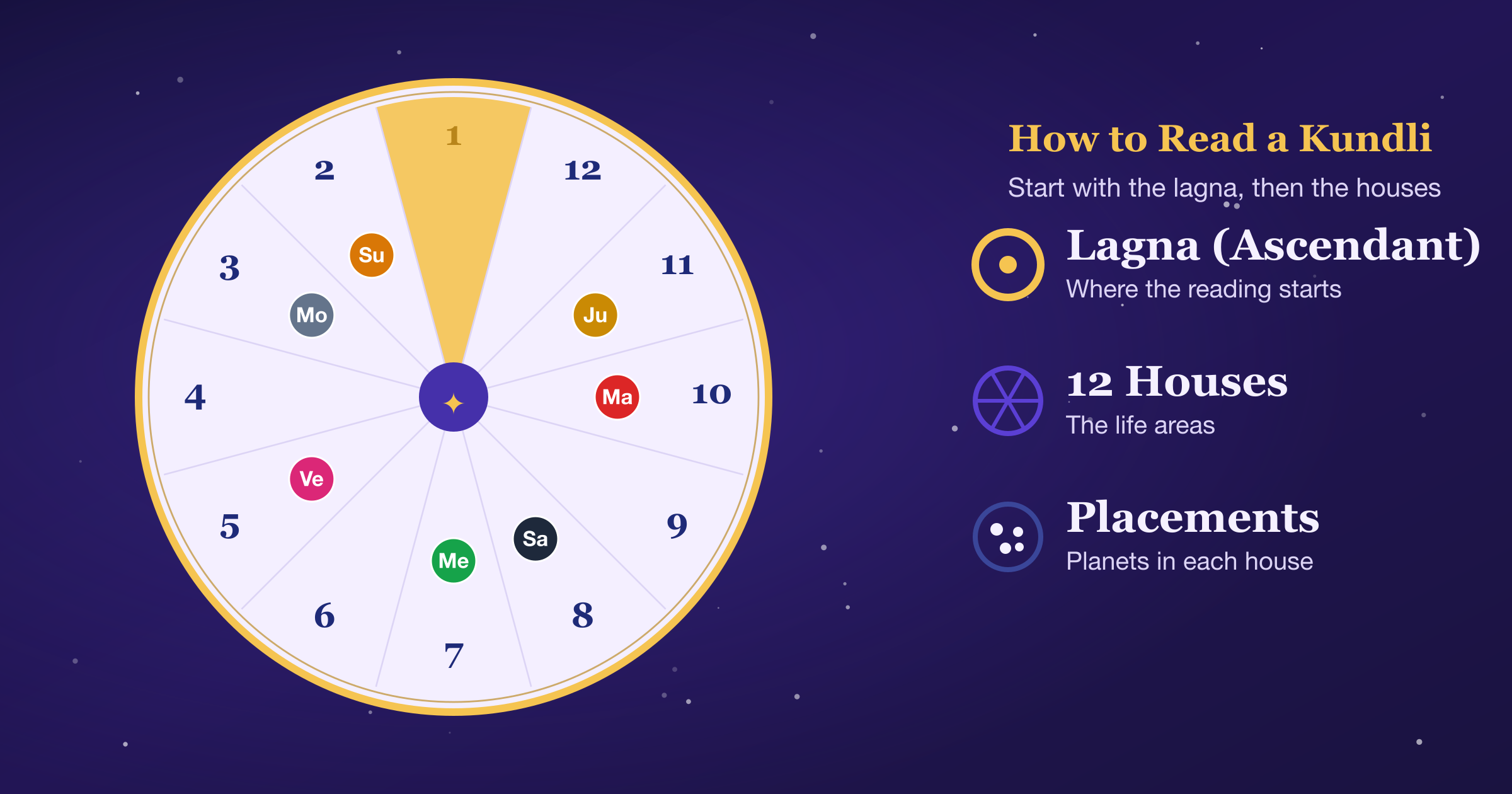
If you want to know how to read kundli, start with the lagna ascendant, not with sun-sign traits. A janma kundali is a birth chart drawn from exact birth time, place, and date, and it becomes readable once you know which house is rising and how the planets fall across the 12 houses.
As of July 2026, this guide uses the same classical reading order used in most Vedic practice: lagna, houses, planetary placements, then nakshatras and timing. If you want the basic vocabulary first, read what a kundli is. If you already have your chart, you can also get your birth chart and follow along.
Key takeaways
- A kundli reading begins with the lagna ascendant because it fixes the house layout.
- Birth chart houses show life areas, while planetary placements show what is happening inside those areas.
- Nakshatras and Vimshottari dasha add detail and timing, but they do not replace the base chart reading.
- A chart is only as useful as its birth data, so exact time matters.
- The goal is interpretation, not fatalism.
Start with lagna, not sun-sign traits
The lagna ascendant is the sign rising on the eastern horizon at birth. In practical terms, it is the first house of the chart, and it sets the order of every other house after it. That is why janma kundali reading begins there. The same Sun sign can behave very differently in two charts if the lagna and houses are different.
For kundli reading for beginners, the first pass is simple:
- Find the ascendant sign.
- Mark the 1st house as the self.
- Count the rest of the houses from there.
- Note which planets are placed in each house.
- Check the Moon's nakshatra for finer detail.
A lot of online advice jumps straight to personality labels. That is too shallow. Vedic reading is not "you are a Leo, so you are confident." It is "your Leo may be in the 10th house, so public life, work, and status become louder themes." The same sign gives a different result depending on the house.
Astrobee's free Vedic astrology tools are built around that chart-first idea, so the reading starts from real planetary math, not generic text. In a good reading, the chart explains the pattern. The sign alone does not.
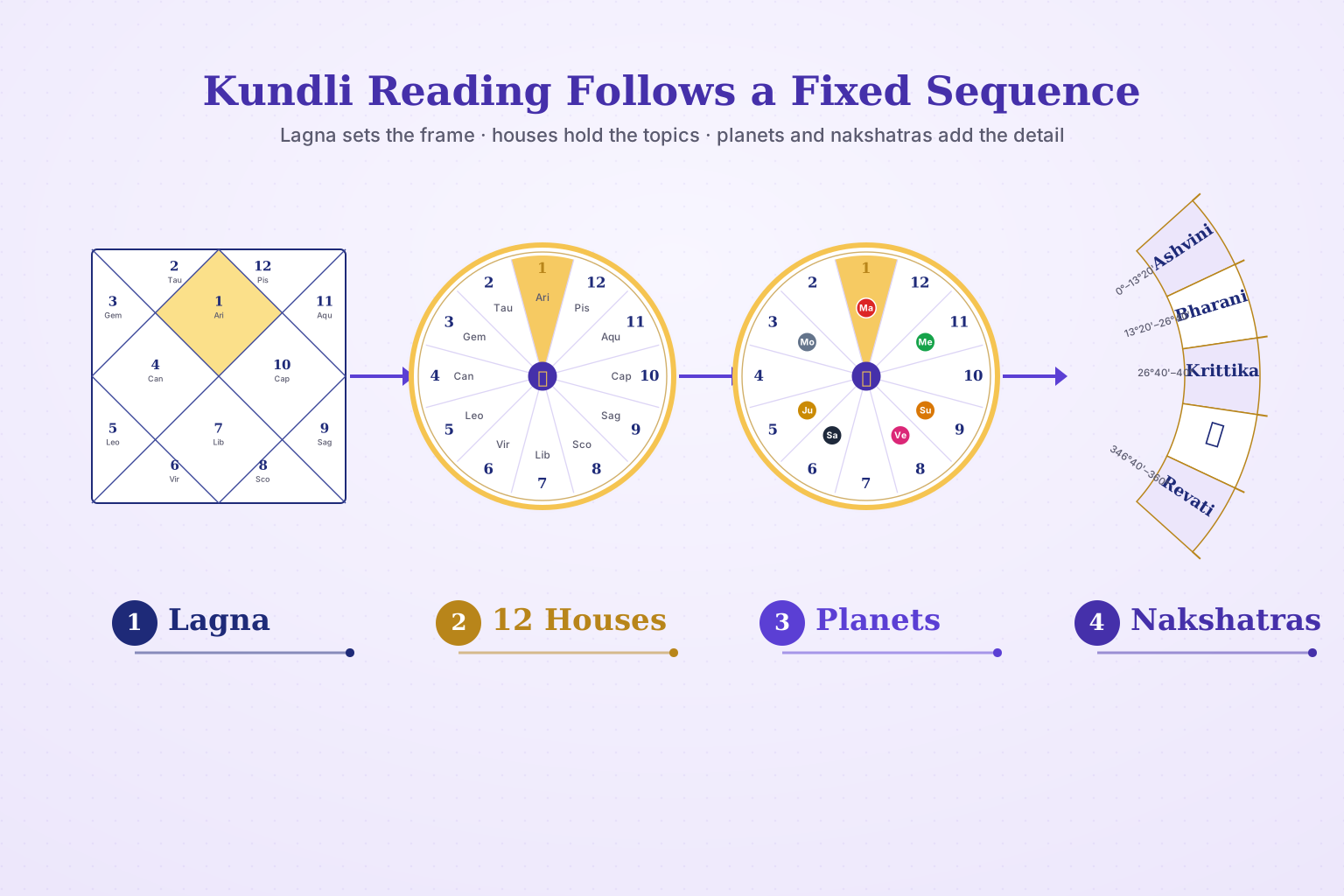
Kundli reading follows a fixed sequence.
If you do not know your exact birth time, begin with a range, not a fake certainty. A small time shift can change the lagna and the whole house structure.
Map the 12 houses in a birth chart
The birth chart houses are the twelve fixed life areas in a kundli, and once the lagna is set, every house is counted from that point onward. A house does not mean the same thing as a sign. The house tells you the topic. The sign tells you the style. The planet tells you what is active there.
Here is the beginner map:
| House | Basic meaning | What to look for |
|---|---|---|
| 1st | Self, body, approach | Lagna, Moon, strong planets |
| 2nd | Money, speech, family resources | Benefics, Saturn, house lord |
| 3rd | Effort, courage, communication | Mars, Mercury, siblings |
| 4th | Home, mother, inner comfort | Moon, Venus, foundation |
| 5th | Learning, children, intelligence | Jupiter, creativity, mantra |
| 6th | Work, conflict, service, health habits | Saturn, Mars, debts |
| 7th | Marriage, partners, contracts | Venus, Jupiter, relationship patterns |
| 8th | Change, secrecy, shared assets | Transformation, inherited matters |
| 9th | Dharma, luck, teachers, beliefs | Jupiter, father, guidance |
| 10th | Career, status, public work | Sun, Saturn, profession |
| 11th | Gains, networks, goals | Large groups, fulfilment, income |
| 12th | Loss, sleep, retreat, foreign places | Isolation, expenses, rest |
Start with the houses that matter most for first-time reading: 1st, 4th, 7th, and 10th. Those four show self, home, partnership, and work. Then read the remaining houses in order if you need more detail.
The same planet can work differently in different houses. Venus in the 4th may support comfort, home, or aesthetic taste. Venus in the 12th may lean more toward privacy, retreat, or foreign settings. The planet did not change. The house changed the expression.
That is why memorising "good" or "bad" planets is not enough. How to read kundli is really the skill of asking three questions at once: what is the house about, which planet is there, and what sign colours it?
Read planetary placements in kundli one planet at a time
Planetary placements in kundli are read by combining a planet's meaning, the house it occupies, and the sign it sits in. In Jyotish, a planet is a graha, meaning a "grasping" force that draws attention toward a particular life theme. You do not read grahas as fixed luck or fixed doom. You read them as functions.
A beginner-friendly way to think about the main grahas is this:
- Sun: identity, authority, vitality
- Moon: mind, feeling, receptivity
- Mars: drive, effort, conflict
- Mercury: speech, logic, trade
- Jupiter: wisdom, growth, teaching
- Venus: attraction, comfort, art
- Saturn: delay, duty, structure
- Rahu: obsession, ambition, amplification
- Ketu: detachment, cut-offs, inward pull
The house placement tells you where the planet speaks. The sign tells you how it speaks. Aspects and conjunctions change the tone again. A strong Saturn in the 10th house can support long-term work and responsibility. The same Saturn in the 4th can make home life feel heavy or duty-bound. Same planet. Different field.
Read a placement in this order:
- Name the house.
- Name the planet.
- Name the sign.
- Ask whether the planet is alone, joined, or aspected.
- Check the house lordship if you want a deeper layer.
House lordship matters because a planet does not only occupy a house. It also owns one or more houses by sign rulership. That is why the Moon can act differently in a chart where it rules important houses versus one where it does not. You do not need to master every rule on day one, but you do need to know that placements are part of a bigger system.
Use nakshatras and dasha to refine the chart
Nakshatras are the 27 lunar mansions, and they refine how a planet behaves. If the sign shows the broad style, the nakshatra shows the finer texture. This is often where a chart starts to feel personal instead of generic.
A Moon in Taurus gives steadiness at a sign level. A Moon in Rohini may show a more sensual, growth-oriented, and material style than a Moon in Krittika, even though both are still in Taurus. That is why two people with the same Moon sign can feel quite different.
Vimshottari dasha is the classical timing system used to see when chart promises become active. It does not replace the base reading. It tells you when certain themes are louder. A strong 7th house may matter more during a Venus period. A difficult 6th house may feel sharper during a Saturn period. Timing matters because the chart is not read as a flat list of traits.
For a beginner, the rule is simple: do not start with dasha. Start with lagna, houses, and placements. Then use nakshatras and dasha to sharpen the picture.
Worked example: read a chart step by step
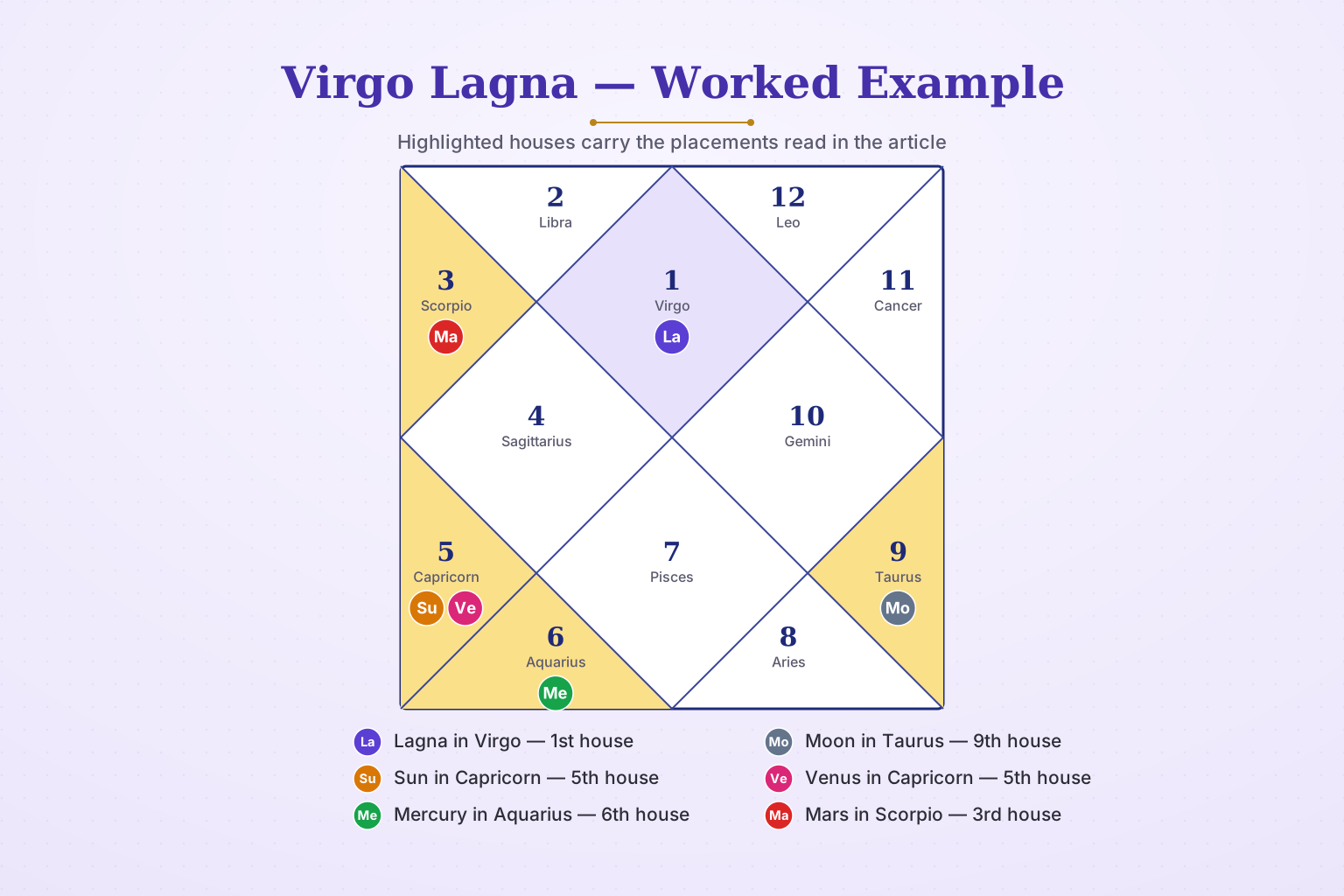
The example reads the chart by house, not by sun-sign traits.
Here is a chart-reading example built with real ephemeris logic. Vedic reading uses the Lahiri ayanamsa, and the chart is built from an ephemeris, the daily table of planetary positions. As of July 2026, that is still the standard way most classical tools calculate a birth chart.
Let us use a sample birth time and place, then read the chart in order:
- Birth details: 14 February 1996, 10:20 AM, New Delhi
- Ascendant: Virgo lagna
- Moon: Taurus, 9th house
- Sun: Capricorn, 5th house
- Mercury: Aquarius, 6th house
- Venus: Capricorn, 5th house
- Mars: Scorpio, 3rd house
Now read it.
Virgo rising makes Mercury the chart ruler. That means Mercury becomes important in how the person approaches life. If Mercury is in the 6th house in Aquarius, the chart may lean toward problem-solving, analysis, service work, or technical thinking. The 6th house is not "bad" by default. It is the house of effort, routines, conflict, and service.
The Moon in Taurus in the 9th house points to a mind that finds comfort in stable beliefs, teachers, and familiar systems of meaning. The 9th house is dharma, learning, and guidance. A Moon there often wants a philosophy that feels reliable, not flashy.
The Sun and Venus in Capricorn in the 5th house suggest seriousness in education, creativity, or romance. The 5th house covers learning, children, intelligence, and past merit. Capricorn adds discipline. Venus adds attraction and taste. Together, they may show someone who treats creative work as something to build, not just enjoy.
Mars in Scorpio in the 3rd house is another strong clue. The 3rd house rules effort, courage, communication, and initiative. Mars in its own sign can make the person direct, persistent, and able to push through resistance. In a practical reading, that may show up as strong writing, advocacy, research, or competitive energy.
The best way to verify this kind of example is to compare the stated placements against a live chart calculation. With Astrobee's free Janma Kundali tool, you can generate the chart first and then check whether the same houses and planetary positions appear in your own case. That is the point of a chart-based method: the reading starts from placements, not from vague labels.
Quick check: if the birth time changes enough to move the lagna, the whole house reading changes with it.
Notice what we did not do. We did not say "this person will be rich" or "this person will marry late." A real reading stays with the chart evidence. It looks at the whole structure, not one dramatic placement.
For readers who want to compare this to a live chart, the same logic applies when you use kundli reading guides or browse birth chart basics. The tool gives you the placements. The interpretation comes next.
How to read your own kundli without overreading it
The safest way to read your own chart is to begin with the houses that carry the most day-to-day meaning: the 1st, 4th, 7th, and 10th. Those four show self, home, partnership, and work. Then add the 2nd, 5th, 6th, 8th, 9th, 11th, and 12th in that order if you want a fuller picture.
Use this checklist:
- Confirm your birth time is accurate.
- Identify the lagna ascendant.
- Read the house ruler of the 1st house.
- Note planets in the 1st, 4th, 7th, and 10th houses.
- Check the Moon sign and nakshatra.
- Add dasha only after the base chart makes sense.
The most common beginner errors are easy to spot. People read only the Sun sign. They mix up signs and houses. They assume one planet decides everything. They also forget that a chart based on the wrong birth time may be pointing at the wrong lagna entirely.
A kundli can tell you tendencies, timing, strengths, and friction points. It cannot tell you fixed fate. It does not replace judgment, effort, or context. That is the honest way to read it.
If you want a chart-specific follow-up, ask a question on chart-based follow-up questions. If you want a fresh chart to practice on, use the free Janma Kundali generator first and then test the reading against real placements.
Frequently asked questions
How to read Kundali for beginners?
The easiest beginner method is to find the lagna, read the 12 houses from there, and then interpret the planets in each house. Start with the 1st, 4th, 7th, and 10th houses first, because they show self, home, partnership, and work most clearly.
How do I analyse my kundli?
Analyse it by combining house, planet, sign, and nakshatra, then checking the house lord and the current dasha. If your Moon is in the 10th house, for example, you read that as emotional investment in work or status, not as a generic Moon trait.
Is kundli 100% correct?
No. A kundli is only as accurate as the birth data, especially the birth time. Even with correct data, it shows tendencies and timing, not fixed events.
Can ChatGPT read kundli?
It can help explain chart logic, but accurate reading depends on correct chart calculation and classical rules. An AI can organise the interpretation, but it should not replace the chart itself.